Monday, November 21, 2016

Review: Samsung’s CFG70 monitor is excellent for competitive gamers and photographers alike

If you're a PC gamer, chances are the average laptop screen or monitor doesn't cut it. For shooter, strategy and fighting games in particular, the average screen is often simply too slow. On the other hand, that speed often comes at the expense of image quality.

Samsung announced its CFG70 monitors in August, and I've had the chance to use the monitor at home for a few weeks. The monitor achieves the difficult feat of mostly fitting my needs both as a gamer and a photographer.

Key Specs and details

  • 24″ and 27″ sizes (I tested the smaller)
  • 1920 x 1080 resolution
  • 1 ms response time
  • 144 Hz refresh rate
  • Curved VA panel (1800R)
  • Quantum Dots color tech with 125℅ of sRGB coverage
  • 3000:1 static contrast ratio
  • AMD FreeSync
  • 2 HDMI, 1 DisplayPort
  • No speakers
  • $349/$449
  • Hardware and design

    Setting up the monitor is easy – basically a matter of dropping it into its swiveling arm stand.

    It's the most versatile stand I've used too; though most allow for some height, swivel, and tilt adjustment, Samsung's also has convenient motion in the Z axis for bringing the screen closer or further, as well as generally a wider range in the other dimensions as well. You can also rotate the screen for use in portrait mode, which I appreciated when editing photos.
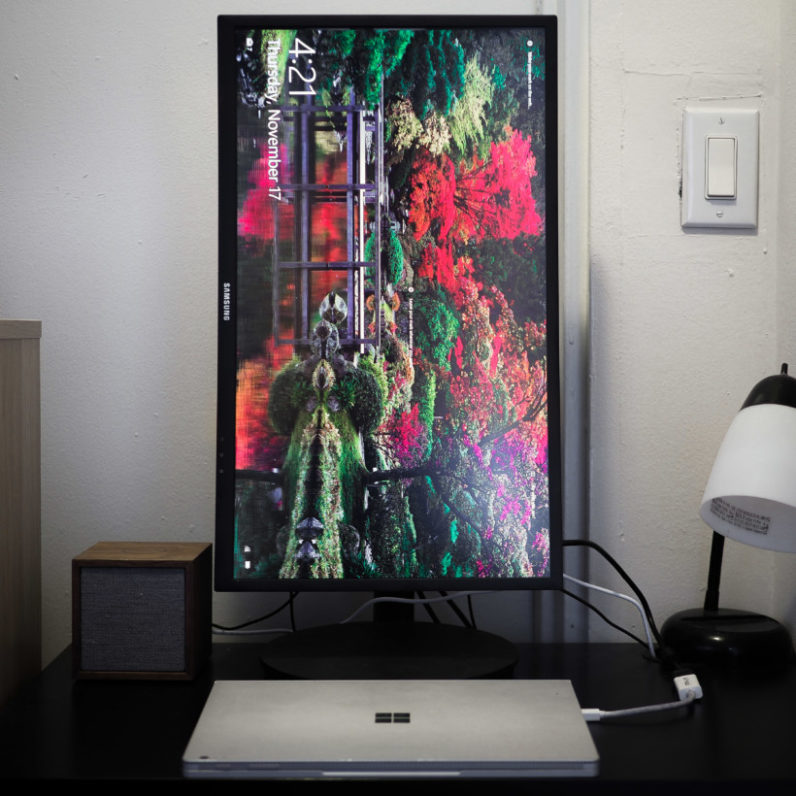
    Samsung CFG70 Monitor

    All these adjustments are easy to make with one hand. My one complaint about the arm mount is that you do have leave a fair bit of space behind the monitor, so keep that in mind if you're buying it for use in tight quarters.

    You navigate menus with a little tilting knob on the back of the display. The menus are intuitive and easy to navigate – including quick overview of your speed settings – and there are three customizable preset buttons under the display as well.

    I'm grateful the display is free of the usual gaming accents with a subdued black design. It doesn't scream "GAMER ALERT" the moment you step into a room.

    The one flashy bit is a glowing blue light under the display. You can set it to pulse, interact with gameplay sounds, or turn off altogether. I would've liked to be able to keep it on permanently, but no luck, so I just turned it off as it was otherwise distracting.

    There are no built in speakers, so you'll have to provide your own or use headphones.

    Image quality

    In a rare turn of events, the specs really do tell most of the story, without many significant qualms or caveats.

    Unlike some curved monitors that I've seen, there was basically no light leakage. Blacks have a bit of a 'glow' but are also on par or better than most IPS panels. Contrast is excellent, as are colors and viewing angles. There's some washing out at extreme angles, but this is largely mitigated by the curvature of the display.
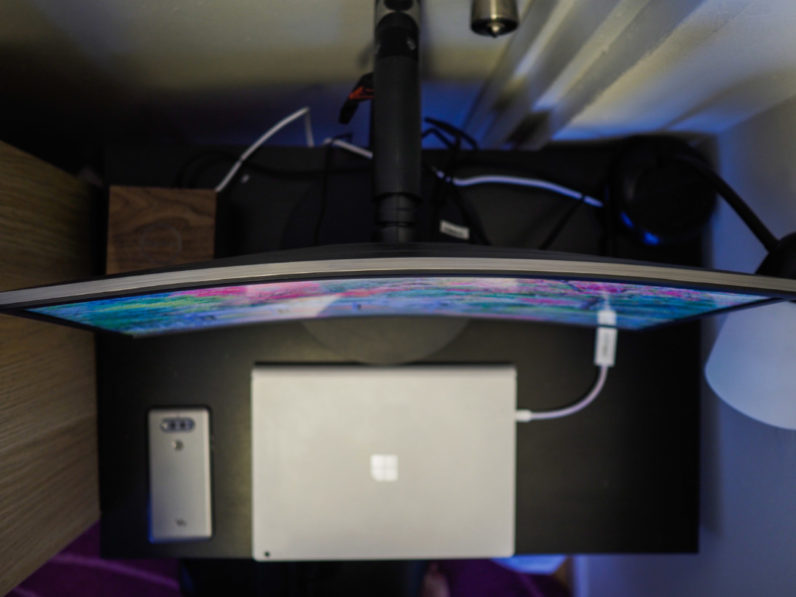
    Samsung CFG70 MonitorThe curvature is neat and doesn't compromise image quality. You can also see how much room you need behind the stand, however.

    I didn't have the equipment for quantitative testing on hand, but it's obviously excellent performance throughout for a monitor that's not specifically aimed at photographers or other media professionals who value accuracy. Though other gaming monitors offer similar responsiveness and lower prices, I've not seen anything else with this degree of color reproduction yet.

    With an excellent stated 125 percent of sRGB coverage (Tom's Guide actually tested it at 151 percent), I just wish it included some other presets like AdobeRGB or DCI-P3 for those of us who need it.

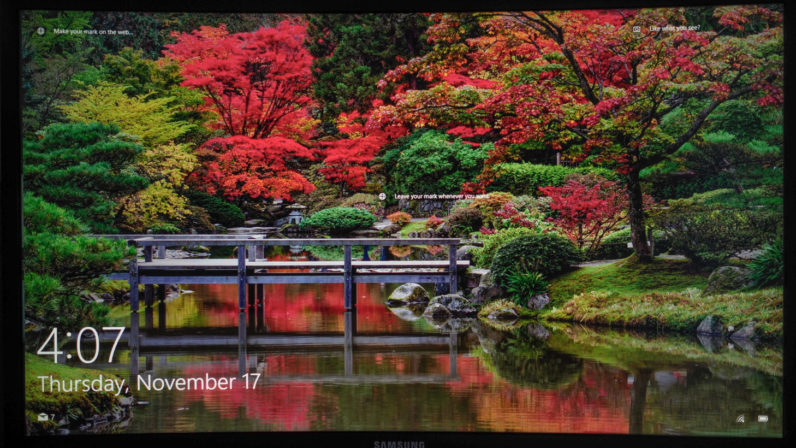
    I used it alongside Dell's quite impeccable 4k (and $1,300) UP3216q, and the Samsung had noticeably better contrast (3000:1 vs 1000:1), with very comparable colors in most apps and games. Colors from the Dell were better with apps that could take advantage of the color management, as you'd imagine, but Samsung puts in an impressive performance for a $350 monitor.
    OLYMPUS DIGITAL CAMERA

    Then there's the matter of Samsung's choice of resolution. After staring at phones, tablets, and laptops with 1440+ screens, seeing 1080p stretched to 24 inches does accentuate the relatively low DPI – it's why I chose to review the smaller model instead of the 27 inch one. At its price, it would've been nice to see at least QHD.

    Still, most people still use 1080p TVs at home, which sit further but are much larger; it all depends on your expectations. I miss the resolution when editing photos (my Surface Book's display is 3000 x 2000), but the excellent colors balance that out.

    Gaming

    Of course, Samsung expects most of the monitor's buyers to be gamers, many of whom don't need or care for a high resolution screen, especially in the competitive arena. Speed and responsiveness come before tiny details that will likely get lost in the heat of game play anyway.

    Though they don't necessary play every game with such settings, a quick gander at this list of settings for professional Counter-Strike: Global Offensive players shows most of them play at 1024 x 768. Even in non competitive games, I'd much rather use better lighting and effects than high resolution. Point is, speed is often more valuable than resolution.

    And speedy this monitor is. If you've never used a monitor with a high refresh rate and low response time, the experience can be a little jarring at first. At 144Hz, it almost looks like your own mouse motions are being fast-forwarded. But once you're used to it, it's hard to go back.

    (For some reason only DisplayPort could hit 144hz; HDMI maxed out at 120hz, though few people would notice a difference.)
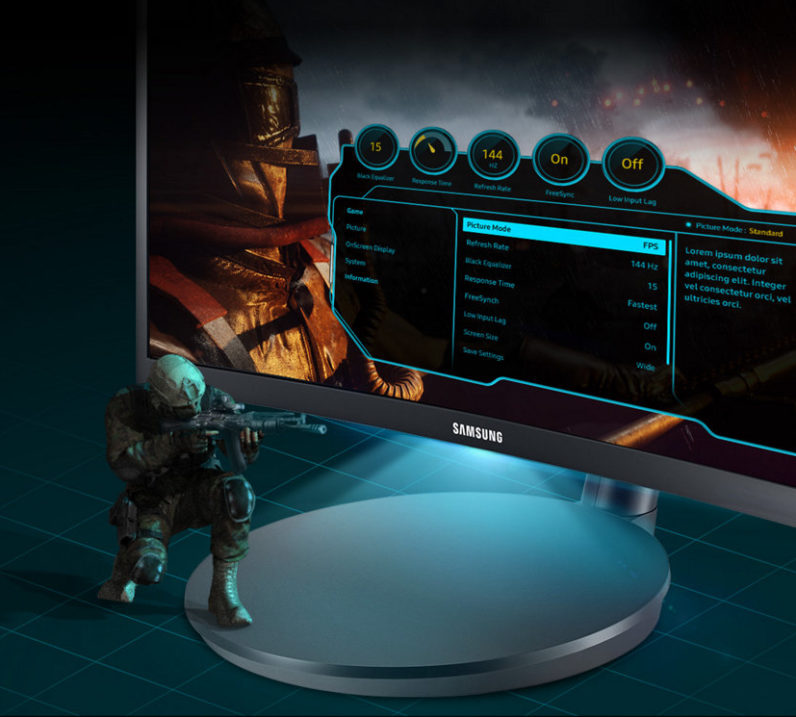
    The OSD menu is intuitive and informative. It doesn't bring lorem ipsum or a mini soldier, however.The OSD menu is intuitive and informative. It doesn't bring that lorem ipsum or a mini soldier, however.

    Most of my testing was done playing CS:GO from my Surface Book (the original 940M-based model) which can maintain framerates above 144 fps pretty smoothly at low settings. That also means I didn't get to test AMD's Freesync, but that hardly matters at this framerate. FreeSync is more useful if you're playing a slower game with higher quality settings where you can hardly hit the max FPS.

    I can't promise the monitor will make you a better gamer, but after several hours of gameplay on the Dell, Samsung, and Surface screens, I consistently fared better on the Samsung.

    Naturally, the refresh rate made motion look more lifelike. Input lag was completely imperceptible in both CS:GO and Smash Bros Wii U, and I couldn't see any ghosting with the 'Fastest' response time setting (there are three levels). Even with the slowest 'Normal' setting, you'd be very hard pressed to see any artifacts. It's also worth noting the 'Fastest' settings locks your brightness, however.

    As for that curve: I've never had strong feelings about curved displays, but I find it useful here. Your eyes are closer to the screen, and it helps everything feel just slightly more immersive, while keeping your eyes relatively equidistant from every part of the screen.

    Moreover, the stand's Z-axis motion makes it easy to pull the screen towards your face in the middle of a game, effectively making it feel larger. I'd normally say the curvature is an unnecessary feature, but given it presents no noticeable disadvantages, I'm glad to have it here.

    Conclusion

    The CFG70 does everything it claims to do, and it does it well. As you'd guess from the spec sheet, it's extremely responsive, but what's more surprising is how good the monitor is when you're not shooting pixelated people in the head.

    As long as you don't mind the resolution and don't need exacting calibration settings, the colors, contrast, uniformity and flexibility make the CFG70 one of your best options for a gaming monitor, and a pretty darn good monitor in general.

    Keep in mind there are cheaper options out there if you just need something with a fast refresh rate and decent image quality from a myriad of brands like ViewSonic, BenQ, AOC, Asus, and others, but you'll be hard-pressed to find something with quite the combination of features and quality on the CFG70.


    Source: Review: Samsung's CFG70 monitor is excellent for competitive gamers and photographers alike

    Sunday, November 20, 2016

    Photographer of the Day: Sohail Karmani

    Category: Travel

    Photographer: Sohail Karmani "Village girl"

    The village girl's eyes, as captured by Photographer of the Day Sohail Karmani, say it all.  She has experienced more than her years. The soft light pulls out her essence. The color of her head scarf blends with the background, framing her face but not detracting from it. I like the simplicity of the photograph.

    The image was taken with an Olympus E-M1, shot at F 1.2, 1/320s, ISO 100, with a 43 mm lens.

    Originally shared on the Photofocus Group on Flickr here.

    To learn how your work can be featured on the Photofocus, please read this article.

    Susan Kanfer A San Diego-based travel photographer, Susan loves to share the world with others, bringing subject matter from far-away places to life. Her images have been seen in numerous publications, both print and web-based, and have been exhibited in several galleries. To learn more about Susan's work visit her website at www.kanferphotography.com. Latest posts by Susan Kanfer (see all)
    Source: Photographer of the Day: Sohail Karmani

    Saturday, November 19, 2016

    Teaching How to Safely Photograph Bullets in Flight

    The high-speed imaging class in the photographic sciences department at RIT has a tradition of photographing bullets in flight. As one of the few schools that train students in the skills required to achieve images like these, I thought it would be worthwhile to explain the equipment and procedures used.

    Although the program has a history of ballistics photography, the program needed to update to new safety standards in order to have a firearm discharged in a laboratory classroom. A procedure was established where a safety officer trained in firearms was the only individual to handle and operate the firearm in the classroom. The firearm used in the lab is a .22 caliber bolt-action rifle. The bolt can easily be removed from this rifle to allow a laser to be positioned down the barrel. This is the quickest way to ensure the alignment of the bullet and the target. When not in use, the rifle is stored in a locked gun safe under the supervision of campus security and only brought to the lab when a ballistics shoot is being performed.

    apple

    apple

    A .22 caliber bullet moving at 1,200 feet per second slices through an apple in the classic high-speed shot. Photographed by Nasser Albahri at RIT.

    The rifle is securely mounted to a gun vise that keeps the barrel aligned with a ballistics sensor, manufactured by Mumford Micro Systems, which is used to trigger a time machine camera controller. The ballistic sensor is made up of two infrared (IR) detectors mounted 4 inches apart. When a bullet traverses the two IR sensors, the microcontroller trips the high-speed flash at a desired time when the bullet is down range from the rifle. The accuracy of the trigger system is so precise that the location of a bullet only varies by a few millimeters from shot to shot.

    tonysafetyofficer

    tonysafetyofficer

    Tony Yazback is the campus safety officer responsible for handling the rifle. The rifle shoots from right to left here. First, the bullet passes through the white tube, which is the ballistic sensor. A white piece of foam core stops a lot of the gun shot residue from getting in the air and basically making a mess. The peach is the target here. The bullet is stopped by the bullet trap held in place with a red strap on the table. The Spot Flash is wrapped in saran wrap to protect the lens and the flash trigger is on the tripod below the flash. The peach is viewed through a large Plexiglas shield.

    For increased safety, the bullet is stopped by a bullet trap that is only a few inches outside the camera frame. The closer the bullet trap is to the target the less the target can cause splatters. This greatly decreases the mess and allows a much easier cleanup. The high-speed flash used in these images is a Spot Flash manufactured by Prism Science Works. The flash is an air gap flash that generates a clean flash with a duration of 500 nanoseconds. It's fast enough to easily capture a .22 caliber bullet.

    After the rifle is positioned to trigger the ballistic sensor, the students are ready to shoot objects that they bring to lab. The safety officer has final approval in what can be shot. Fruits and vegetables are acceptable, while hard objects like snow globes and alarm clocks are rejected due to the chances of a ricochet bullet. To guard against any unforeseen ricochets, the students are required to stand behind two large Plexiglas screens. Students are also required to wear safety glasses and ear protection during the lab.

    Students aligning cameras and checking their exposures before a shot. They keep the shutter open and allow the fast flash to stop the action.

    Students aligning cameras and checking their exposures before a shot. They keep the shutter open and allow the fast flash to stop the action.

    Students aligning cameras and checking their exposures before a shot. They keep the shutter open and allow the fast flash to stop the action.

    The students use an open shutter technique to capture the images. The subject to be shot is placed on a stand. The position is adjusted to take into consideration the amount the bullet will slow down going through the target. The flash is triggered by hand to tests the exposure and focus. After the students all have focus and exposure set, the rifle is loaded. Everyone in the room is checked to see that safety glasses and ear protection are in place before the photography can start. The room's lights go out, camera shutters are opened, the safety officer fires the rifle, and camera shutters are closed. Only after all the camera shutters are closed are the lights turned on again and the exposure checked. Using this procedure, we are able to limit risk and safely achieve some amazing high-speed images.

    Students from this program find employment at a number of industries that utilize high-speed imagery. Former students are employed by NASA, Sandia Laboratories, and The Insurance Institute of Highway Safety.

    Eggplant by David Lopez

    Eggplant by David Lopez

    Eggplant by David Lopez

    Apple by David Lopez

    Apple by David Lopez

    Apple by David Lopez

    The classic playing card shot. Photo by David Lopez.

    The classic playing card shot. Photo by David Lopez.

    The classic playing card shot. Photo by David Lopez.

    Homemade ballistics jello is just uncolored jello made at three times the normal strength. Note the bullet is moving sideways. Photo by David Lopez.

    Homemade ballistics jello is just uncolored jello made at three times the normal strength. Note the bullet is moving sideways. Photo by David Lopez.

    Homemade ballistics jello is just uncolored jello made at three times the normal strength. Note the bullet is moving sideways. Photo by David Lopez.

    I would like to extend special thanks to the following people that make these unique labs possible. Anthony Yazback (campus security), Michael Peres, Dr. Mary Mulligan, Amanda Kearney (Video supervision). I would also like to thank the students in the class for sharing images for this short article.


    Source: Teaching How to Safely Photograph Bullets in Flight

    Friday, November 18, 2016

    Photographer of the Day: Marcos

    Vanelli Robert Vanelli (Vanelli to his friends) is a working photographer, educator and author living in Florida. After a successful career as a three-time, Triple Crown Karate champion, Vanelli turned his attention to teaching the visual arts. As an experienced educator, Vanelli has created several photography and digital workflow programs including Click for Kids.

    Currently he is teaching workshops, writing for Photofocus and creating tutorials for various plug-in companies and for the Vanelli and Friends series.

    You can find out more about Vanelli at www.VanelliandFriends.com


    Source: Photographer of the Day: Marcos

    Thursday, November 17, 2016

    It Was Only A Matter Of Time Until Our Spies Caught The BMW X2 Testing

    by Jay Traugott8,920 reads

    Despite the camo, it looks a lot like the slick X2 Concept.

    It was only a month or so ago that we first laid our eyes on the BMW X2 Concept at the Paris Motor Show. Now our spy photographers have caught BMW testing an X2 development mule on the streets of Munich, Germany. Despite the heavy camouflage it is, essentially, an X1 with an even sportier body. For example, the lower roof makes the X2 look wider and more masculine. Unlike the larger X4 and X6, the upcoming X2 won't have a more coupe-like appearance and we think that's a good thing.

    After all, the X4 literally looks like a smaller version of the X6, and it would have been a shame if BMW continued that policy with the X2. Great to see something different is being done here. Like the X1 on which it's based, the X2 will ride on a front-wheel-drive platform. All-wheel drive will be optional on xDrive models as well as a possible X2 M. As far as powertrains go, expect to see the same engines offered in the X1, such as the turbocharged 2.0-liter inline-four with 228 hp and 258 lb-ft of torque. The Euro-spec X1 has a diesel option but we're still unsure whether that'll arrive stateside. However, don't be surprised to see a plug-in hybrid variant in the near future for both the X1 and X2.

    We don't know when exactly BMW will reveal the production ready X2, but the 2017 Geneva Motor Show in March or the Frankfurt Motor Show next September are two good guesses.


    Source: It Was Only A Matter Of Time Until Our Spies Caught The BMW X2 Testing

    Wednesday, November 16, 2016

    Picture of school boy in uniform wins Swiss photographer £15,000 Taylor Wessing prize

    London's National Portrait Gallery has announced the winner of its annual Taylor Wessing Photographic Portrait Prize, with Swiss photographer Claudio Rasano scooping the top award of £15,000. The winning image, of a school boy from South Africa, was part of a series studying how people can remain individuals while wearing the same uniforms. Rasano has featured in the short list for the prize in two previous years, but this is the first time he has won.

    Second prize went to Joni Sternback for a tintype portrait of a pair of surfers which won him £3000, while the £2000 third prize went to Kovi Konowiecki for a picture of a pair of Jewish girls. Both photographers are from America.

    The competition also provides an additional £5000 prize for a photographer under the age of 35, which was won by the UK's Josh Redman. His John Kobal New Work Award grants him a commission to photograph someone from the UK film industry for the gallery's collection.

    The winning images, along with over fifty other entries, can be seen at the National Portrait Gallery in London until the 26th February. Entrance is £6. For more information visit the National Portrait Gallery website.

    Claudio Rasano won the Taylor Wessing Photographic Portrait Prize 2016 for his portrait of a Johannesburg schoolboy, the National Portrait Gallery has announced. The prestigious £15,000 award was presented to the Swiss-Italian photographer at an awards ceremony last night (Tuesday, 15 November 2016).

    The winning portrait, part of Rasano's series Similar Uniforms: We Refuse to Compare, was taken in February 2016, in Johannesburg, South Africa and focuses on issues of preserving individuality in the context of school uniforms. The photograph was shot in daylight, outdoors and in front of a plain white paper background. The sitter for this particular inkjet print is eighteen-year-old Katlehong Matsenen.

    Rasano explains: "Children themselves have been known to rebel against uniforms, especially as they approach the awkward age characterised by the need to fit in and the desire to stand out, all at the same time. Some experts too have spoken against school uniforms on the grounds that they suppress individuality and diversity."

    Claudio Rasano was born in 1970 in Basel, Switzerland. His work has been included in numerous international exhibitions and previously featured in the Taylor Wessing Photographic Portrait Prize in 2011 and 2013. Rasano's awards include the Shortlist for the Athens Photo Festival, 2016; Bieler Fototage 2015; Leica Oskar Branack Prize 2015 and a finalist in the Photography Masters Cup 2015.

    Second prize has been awarded to Joni Sternbach's large-format tintype portrait of surfers Thea Adler and Maxwell Schultz and third prize has gone to Kovi Konowiecki for his photographs Shimi Beitar Illit and Tilly and Itty Beitar Illit part of a series of inkjet prints that portray Orthodox Jews from around the world. The John Kobal New Work Award, worth £5,000, was won by Josh Redman for his portrait, Frances.

    The winning portraits will be on display as part of the Taylor Wessing Photographic Portrait Prize 2016 exhibition from 17 November 2016 to 26 February 2017. The annual exhibition is one of the most prestigious photography awards in the world and showcases new work that has been submitted by some of the most exciting contemporary photographers. Since the international competition began in 1993, it has remained a hugely important platform for portrait photographers and offers an unparalleled opportunity for celebrated professionals, emerging artists and amateurs alike.

    The competition judges had no knowledge of the identity of the entrants, and the diversity of styles in the exhibition reflects the international mix of entries as well as photographers' individual and varied approaches to the genre of portraiture. For the second time, photographers were encouraged to submit works as a series in addition to stand-alone portraits, and there was no minimum size requirement for prints. This year, for the first time, the rules also allowed photographers to submit photographs on diff erent supports to the competition – to encourage the demonstration of a range of different photographic processes.

    The prize-winning photographs and those selected for inclusion in the exhibition were chosen from 4303 submissions entered by 1842 photographers from 61 countries.

    Dr Nicholas Cullinan, Director, National Portrait Gallery, says 'My congratulations to Claudio Rasano for his winning portrait of schoolboy Katlehong Matsenen taken in Johannesburg earlier this year. The quality and diversity of both this year's shortlist and exhibition are a testament to the engaging work being produced by international photographers. Each and every photographer who entered has contributed their part to the debate and evolution of contemporary portrait photography.'

    Tim Eyles, Managing Partner, Taylor Wessing LLP, says: 'One of the great joys and honours of sponsoring the Taylor Wessing Photographic Portrait Prize for the past nine years- and being part of the jud ging panel- is having the rare opportunity to catch an intimate glimpse into the lives of people from around the world. Each winning portrait tells a different, unique story and builds a genuine connection between the viewer, the subject and the photographer. I hope that you will share our enjoyment of the photographs in this year's exhibition, and join me in congratulating the photographers whose portraits are featured.'

    American artist Joni Sternbach was born in the Bronx, New York and is a Visiting Artist at Cooper Union School of Art, faculty member at the International Centre of Photography and The Penumbra Foundation in New York, where she teaches wet plate collodion. Sternbach uses early photographic processes to create contemporary landscapes and environmental portraits, centring on man's relationship to water. Her series Surfland, features large-format tintype portraits of surfers. Her prize-winning portrait was taken in February 2016 at Davenport Landing, Santa Cru z, California, USA. Sternbach says: 'For me, this photograph represents many of the challenging aspects of creating a portrait. I was in an entirely new location and faced with people I'd never met before. In this spectacular environment, I aimed to create a dynamic complexity within the picture that was both unique to that person and also understandable to others.'

    American artist Kovi Konowiecki was born and raised in Long Beach, California. After pursuing a professional career in football, Konowiecki is in the final stages of an MA in photography at the University of the Arts, London. His work lies between documentary and fine art, often focusing on portraiture and telling stories that also reveal his identity, and his experiences of growing up in Long Beach. Shimi Beitar Illit and Tilly and Itty Beitar Illit are part of a series of inkjet prints that portray Orthodox Jews from around the world. The colours and floral background create a painting-like quality, highlig hting the mysticism of the subjects and their association with a history that many may find unfamiliar.

    Konowiecki explains: 'When I set out to photograph the faces of Orthodox Jews around the world, it was an attempt to both strengthen my ties to my family's history and shed light on the traditions of a people that seem strange to modern society. The project started by contacting members of the Jewish community from where I grew up, and evolved into travels across the world to capture Orthodox Jews who, although they live thousands of miles apart, are bound together by history, tradition and a set of values that serve as the cornerstone of the lives of many who live in today's society.'

    £5,000 John Kobal New Work Award: Josh Redman for Frances

    The £5,000 John Kobal New Work Award has been awarded to Josh Redman for his photograph Frances, from an on-going series of pared down studio portraits. Redman says, 'This was Frances's first serious photo shoot, and it's an honour to have been part of her initiation into modelling at age 83. During the 3-hour sitting we chatted over pastries about her late husband, the War, her lifelong job as a typist and her daughter Tineka.' Born in the UK in 1984, Redman was a sculptor and potter until 2012 when he decided to sell his kiln, buy a camera and move to London. Since then he has worked as a freelance photographer, winning the AOP Assistant Award in 2014 and has been commissioned by Adidas, SKY TV and The British Museum amongst others.

    The John Kobal New Work Award is given to a photographer under thirty-five whose work has been selected for the Taylor Wessing Photographic Portrait Prize exhibition. The winner receives a cash prize of £5,000 to include undertaking a commission to photograph a sitter connected with the UK film industry for the Gallery's Collection.

    The competition was judged from original prints by Dr Nicholas Cullinan, Director, National Portrait Gallery; Dr Phillip Prodger, Head of Photographs, National Portrait Gallery; Carole Sandrin, Curator, Musée de l'Elysée, Lausanne; Christiane Monarchi, Editor Photomonitor; Nadav Kander, Photographer and Tim Eyles, Managing Partner, Taylor Wessing LLP.

    The exhibition also features an In Focus display of previously unseen prints from a new body of work by the award-winning Spanish photographer, Cristina de Middel. The photographs, making their international debut in the exhibition, are part of the series 'Gentleman's Club', taken of prostitutes' clients in brothels in Rio de Janeiro, Brazil. By recruiting her sitters through a newspaper advert, she inverted the normal roles of the business by placing herself in a position of power. Sitters were asked about their e xperience, personal history and motivations. In Focus is an annual showcase for new work by an internationally-renowned photographer, which is exhibited alongside the images selected for the Taylor Wessing Photographic Portrait Prize 2016. De Middel is the second In Focus artist, selected by the Gallery's curators, following last year's inaugural display which featured the work of Pieter Hugo.

    TAYLOR WESSING PHOTOGRAPHIC PORTRAIT PRIZE 201617 November 2016 – 26 February 2017Tickets with donation: Full price £6, concessions £5 / Tickets without donation: Full price £5, concessions £4 (Free for Members and Patrons) Supported by Taylor Wessing npg.org.uk/photoprize #photoprize

    PUBLICATIONA fully illustrated paperback catalogue including all photographs from this year's exhibition features an interview with the In Focus photographer Cristina de Middel and interviews with the prize-winners by Richard McClure. RRP £15 with a special price of £9.99 when purchased directly from the National Portrait Gallery shops.

    Prizes: First prize is £15,000, second prize is £3,000, and third prize is £2,000. The winner of the John Kobal New Work Award receives £5,000.

    Tour: The exhibition will tour to Sunderland Museum and Winter Gardens from 18 March – 4 June 2017 and The Beaney House of Art and Knowledge, Canterbury from 8 July – 29 October 2017.


    Source: Picture of school boy in uniform wins Swiss photographer £15,000 Taylor Wessing prize

    Tuesday, November 15, 2016

    Photographer of the Day: Martin Reisch

    Category: Fashion

    Photographer: Martin Reisch"Distance"

    Photographer of the Day, Martin Reisch, places two models in an out-in-the-country setting. The styling is wonderful, right down to the gloves. The blue gloves give a pop of color for the neutral colored masculine look of boots, slacks, and fur collared jacket while the brown gloves compliment the red hair of the model dressed in a subtle plaid skirt. The soft light coupled with the semi blurred background focuses attention on the models and their clothes.

    Originally shared on the Photofocus Group on Flickr here.

    To learn how your work can be featured on the Photofocus, please read this article.

    Kevin Ames Photography is life. Kevin is living it to the fullest. His practice includes fashion, editorial, architectural and corporate photography. Most of all he loves making photographs! Read his blogs here and at www.kevinamesphotography.com. Latest posts by Kevin Ames (see all)
    Source: Photographer of the Day: Martin Reisch