Sunday, January 22, 2017

Snaphubr is a stock photography website for African photographers, photojournalists to earn

Share

Share

Email

Snaphubr, is an image stock platform similar to Shutterstock, but exclusively dedicated to African-related content offering professional photographers the opportunity to earn money by uploading high-resolution African pictures of guests taken at events on event.snaphubr.com.

Oluwaseun Babajide, the Chief Executive Officer, Snaphubr Investment Limited said, "The era when African event and celebrity photographers, as well as photojournalists, did not get monetary rewards for their works is gone, as Snaphubr Investment Limited has launched a stock photography website, Snaphubr.com to give them a chance to earn from their photography skills and hardwork regardless of their location on the continent."

Snaphubr also aims to cater to guests whose photographs at events are not actually delivered denying event photographers an opportunity to earn monetary rewards from their work. However, by simply uploading their event photos on the site, guests can claim and use any pictures uploaded for as low N315 ($0.99).

Babajide says the photos on the site are of high resolution, original and are powerful tools for personal use, corporate marketing and branding.

"An image is a representation of your brand and this is why it is important to make sure you are choosing the right high-quality image from Snaphubr.com," Babajide said. "Therefore, if you ever had a hard time finding high-resolution African images, your search now ends at Snaphubr.com, a platform aimed at pushing indigenous photographers and quality African images."

At the moment, Snaphubr.com has over seven million high resolution African images provided by African photographers for Africa and beyond.

"Our recent partnership with YAY images has further strengthened our ability to provide authentic and realistic images that you won't find anywhere else. In all, Snaphubr provides an easy to access and affordable means to boost the marketing of your business and take it to a whole new level with lovely photographs and images," he said.

Snaphubr is open to individuals who are motivated and smart, and want to be a part of the platform changing lives and brands across Africa and the world. The platform's mission is to help individuals make a decent income, whether they are professional photographers or students in college or even stay at home dads or nannies as long as they have a passion for photography and can take great shots. Everyone has the potential to earn money from their photos.

In order to engage professional photographers, the company has also launched another platform event.snaphubr.com. It is a reward system for photographers where they can upload and sell pictures of event guests.

"It often happens that pictures of guests taken by photographers at an event do not actually reach the guests even though guests have requested to send them at a later date. Even if the guests get those images, the photographer doesn't get monetary reward for it.

"Snaphubr has recognised this problem and, therefore, has come up with a solution that helps photographers get monetary reward for disseminating images to guests from an event," said the CEO.

The event.snaphubr.com is a platform designed to actually record event and upload pictures of guests taken from an event for easy claims. The guests can actually claim their pictures for as low $0.99 (N350).


Source: Snaphubr is a stock photography website for African photographers, photojournalists to earn

Saturday, January 21, 2017

KU hoops replay: Jayhawks 79, Texas 67

No. 2 Kansas faces Texas at 1 p.m. Saturday at Allen Fieldhouse in Lawrence. TV: CBS. Radio: KCSP (610 AM). Follow along with live updates from Kansas beat reporters Gary Bedore and Jesse Newell, who will answer your questions during the game, as well as other Star sportswriters, editors and photographers.


Source: KU hoops replay: Jayhawks 79, Texas 67

Friday, January 20, 2017

Why Landscape Photography Isn't Always Glamorous

As we start filming our newest tutorial, "Photographing the World With Elia Locardi 3," this seems like a timely video. When we see the gorgeous images landscape photographers produce, it's easy to think that landscape photography is an ideal profession for spending all one's time taking images of the most beautiful places on the planet, but the reality isn't always that glamorous.

Like any job that produces a beautiful product, it's easy to gloss over the day-to-day tedium and downsides that go into producing said product, but this video is a great look at what really goes on behind the scenes in landscape photography. I appreciate that it provides a very real, unglorified look at the profession, paying tribute to the miles walked, the elements braved, and the hours waited all for a single shot that might not even make itself available. What seems like a job anyone would love to have is actually something that takes tremendous amounts of hard work and devotion to unglamorous things, something I really connected with as a musician. Heaton even shows us that landscape photographers are humans who make mistakes just like the rest of us, though his resourcefulness saves the day.

Be sure to check out Heaton's website for more.

[via PetaPixel]


Source: Why Landscape Photography Isn't Always Glamorous

Thursday, January 19, 2017

How A 2-Year Old “Makes” Cereal

Founded in 2011, the Click Pro Daily Project was the industry's first group photography blog and has brought together hundreds of female photographers. Dozens of inspirational photos are posted daily, and participants are encouraged to share camera settings for each image so that the project can become a source not only of inspiring photographs for viewers, but also an educational resource.

Learn more about Click Pro and Apply to Join


Source: How A 2-Year Old "Makes" Cereal

Wednesday, January 18, 2017

On The Eve Of Trump’s Inauguration, This Exhibition Of Protest Photography Is As Fresh As Ever

How exactly should one photograph a political demonstration? There are a few schools of thought, I imagine, and it may be helpful to think of these approaches in similar terms to those used to discuss the various approaches to literary translation – both translators and photographers work across languages in order to best make a work intelligible to different audiences. In the case of the photographer, the translation occurs across mediums instead of languages. The political photographer must take an act of public theater (protests don't just employ the theater as a means of advancing political programs; protests are themselves a type of performance), and turn the transitory into the concrete, that is, into an object that may be reproduced, disseminated, and dissected. In other words, the photographer must translate the protest into an image in order to make it intelligible to those who were not present.

So what are the possible approaches? First, there is the idea that a photograph of a political demonstration should convey the protestors' message as accurately and as faithfully as possible. The viewer of such a photograph should be able to glean the mission, context, and content of the protest with relative ease – photography as mission statement.

The second approach would be to capture the "feeling" of the moment or the text. The photograph may be devoid of orienting context, and the viewer may be unsure what exactly is being protested, but the feeling of the moment may be effectively communicated – and through this emotional content, the viewer will have understood something essential about the specific moment and about protest in general. Photographs like these can therefore be abstracted and used for myriad purposes – thus speaking to their aesthetic merits, but perhaps dulling their impact as tools for a specific cause.

Finally, a political photograph may fall into some middle ground between the other two approaches– it will preserve the emotional immediacy of the moment as it was lived while simultaneously supplying enough context for the viewer to ground the image in relation to a specific issue. All three approaches are represented by the photographs at "Whose Streets? Our Streets!" an exhibition of New York protest photography between 1980 and 2000 which recently opened at the Bronx Documentary Center (full disclosure – I currently write for Reading the Pictures, which is edited by Meg Handler, one of the curators of the exhibition).

Because I attended the exhibition on opening night, my viewing experience was slightly different than the average viewer's is likely to be. The exhibition took place in a small room that was made even smaller by the booth serving food and beer, the table where prints and books were sold, and a hanging piece displaying newspaper and magazine covers by the north wall. The room was packed with people (many of the photographers whose photos were on display were also present). I arrived about an hour after the official opening, and by the time I had made my way over to the west wall of the exhibition, the display most heavily saturated with photographs, all of the accompanying informational sheets had been taken. I was therefore left to my own devices when it came to figuring out what the photographs were trying to depict.

The absence of context however only enhanced my experience of the exhibition and I would recommend that everyone look at the photographs unguided before turning to the informational sheets. Viewing in this way forces you to focus on the aesthetic value of the photographs while simultaneously considering just what it is you are looking at – coming into the viewing experience with prior information can put the primacy on the message instead of the medium (if you attend the exhibition on a night when they have run out of informational sheets, there is an incredibly comprehensive website that provides context and insight into the photographs on display). And many of these photographs, in addition to forcefully putting forward a political statement, are also incredible in terms of their composition, poise and execution.

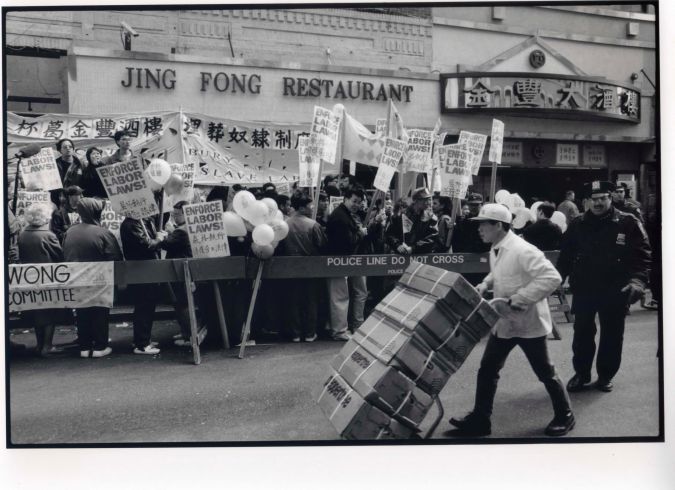
Consider this image by Corky Lee:

© Corky Lee

Because we read text from left to right, we also tend to read images in the same way – the left is the "beginning" of the image, so to speak (the reverse pattern holds true for people who read languages that are written from right to left). At the "beginning" of Lee's picture, we see a cluster of protestors holding signs that say "ENFORCE LABOR LAWS" against a backdrop of Chinese lettering. The first connotation for a western viewer is likely a sweatshop, but as we continue tracking left, we see that the protestors are outside of the Jing Fong Restaurant. We can also finally see the text of the large banner behind the protestors – "SLAVE" followed by "LAB" from which we can extrapolate the phrase "SLAVE LABOR." So far we have been tracking the middle ground and background of the "first" 2/3 of the image, but as we enter the last third, our focus shifts to the foreground where we see a man in a white coat pushing five boxes on a trolley. It is sa fe to assume that he is a worker for the Jing Fong Restaurant. The image of the laborer against the backdrop of a labor protest informs what we would usually consider to be a mundane action in a sinister light – this is no longer just "labor" this is "exploited labor" or, as the banner suggests "slave labor." The message is further driven home by the rightmost element of the photograph, the police officer. In reality, the officer was likely there simply to keep order, but in the context of the narrative of the photograph, the tone of which has been set by the protestors, the officer looks less like a keeper of the peace than an enforcer, an overseer, following behind the laborer to ensure that he continues his work.

Lee's photograph is both an aesthetic and political success. The compositional technique of the photograph gives the viewer a narrative lens through which to interpret the events, and that narrative lens is certainly sympathetic to the protestor's cause. The effect, both artistically and politically (the two cannot really be separated here), is immediate. The photograph follows our third approach to translation.

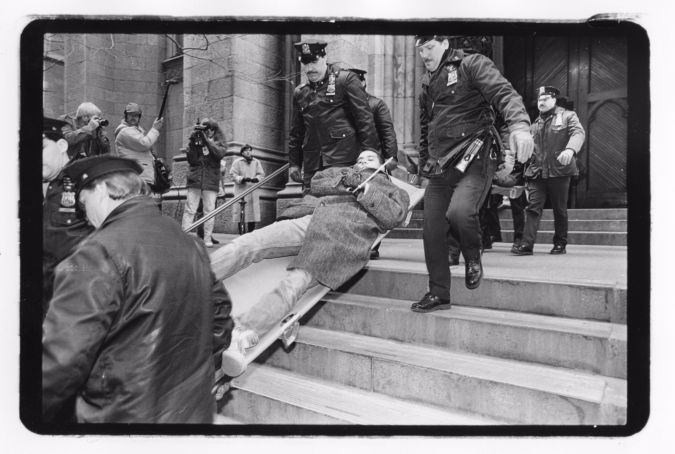
Other images in the exhibition fall into the two other approaches (this is not a value judgment – simply a manner of grouping). This image by Brian Palmer of a young man on a stretcher being taken down the steps of a Church by the police can serve as an example of a photograph that is immediately emotionally effective, but disorienting in terms of political content.

© Brian Palmer

We are immediately drawn to the man on the stretcher in the center of the photograph. Is he wounded? Is he dead? If so, how? Why is he being carried by the police and not an ambulance crew? Without context, it appears as if some kind of violent crime has occurred in the Church and this man is either its victim or its perpetrator (which may explain the police). The image of a wounded man on a Church's steps, arms seemingly crossed in repose, flirts with the iconography of religious funerals, and evokes feelings of reverence, pity and indignation. He seems somehow holy, while the police presence (the police as a representation of the state monopoly on the legal use of violence) at a site of worship and "peace" is somehow a desecration, hence the indignation.

In reality, however, the man on the stretcher is not wounded – he is a protestor from ACT UP, an AIDS activism group. The man was arrested during the "Stop the Church" action – a protest against St. Patrick's Cathedral in response to Cardinal John O'Connor's anti-gay, anti-condom, anti-sexual education comments. Once we know the context for the photograph, the zip tie on the man's wrists comes into focus, and the man on the stretcher becomes the invasive presence, not the police. Without the context, the man on the stretcher draws the sympathy of the viewer. Of course, he continues to do so within the context as well, but to a more conservative minded viewer, the image seen without context, then with, might inspire some conflicting feelings – the religious super-ego shutting down the prior emotional response.

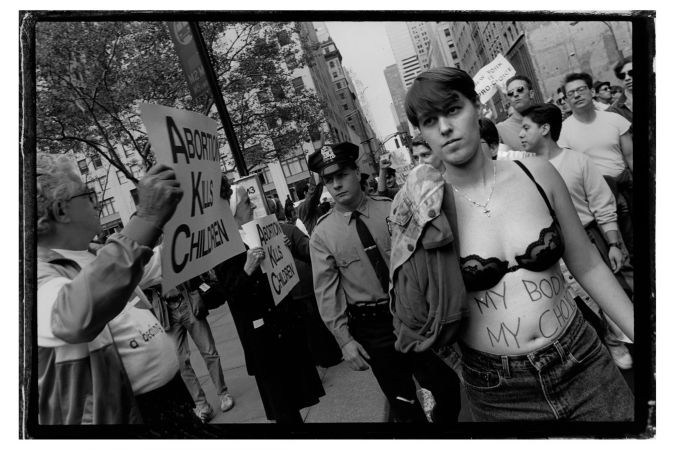
As an example of the literal, we can look to this photograph by Sandra Lee Phipps:

© Sandra Lee Phillips

Here we see a woman with "MY BODY MY CHOICE" written on her stomach, flanked by protestors wielding "ABORTION KILLS CHILDREN" signs. The narrative content of the photograph is clear – here we have a pro-choice protest with an anti-abortion (anti-choice) counter-protest. We immediately know the message. The photograph still, is incredibly well composed. The pro-choice protesting woman is surrounded on all sides, on the left by the anti-abortion rally, on the right, by a group of men (who seem to be a part of the pro-choice rally, but their status is ambiguous), and behind, by a police officer, that is, by the state. The image is claustrophobic, and the woman's isolation offers an "us against the world" story, but because the immediate circumstances of the photograph are readily apparent, it is unlikely to cause any manner of emotional-ideological cross-firing as in the case of the Palmer photograph – which makes it perhaps more effective as a pro-choice statemen t.

The exhibition features an enormous wealth of material, representing a number of issues with images that are by turns intimate and explosive. In a brief speech given halfway through the exhibition, curator Meg Handler said that when she and co-curator Tamar Carroll conceived the exhibition they anticipated that they would be "celebrating the victory of the first female president," not nervously awaiting the inauguration of Donald Trump. But in light of Trump's election, the timing of the exhibition could not be better. Not only can it serve as an inspiration for future protests, but it can also give us a refresher course on how to effectively document those protests. And, insofar as a protest seeks to be more than locally effective, documentation is what truly makes the action.

Jake Romm is the Forward's culture intern. Contact him at romm@forward.com or on Twitter, @JakeRomm


Source: On The Eve Of Trump's Inauguration, This Exhibition Of Protest Photography Is As Fresh As Ever

Tuesday, January 17, 2017

Adger Cowans Gets His Due as a Great Photographer

One of our greatest but too often overlooked contemporary photographers, Adger Cowans has been shooting indelible images for more than half a century.

We could all use a respite from the craziness in the air these days. So for a much-needed dose of spiritual nourishment and artistic inspiration, look no further than Personal Vision, the handsome new monograph of the photographer Adger Cowans's terrific body of work. Cowans, now 80, began taking pictures in college, then in the Navy, and later served as an apprentice to Gordon Parks. He broke into the world of photojournalism and fashion photography in the late '50s and early '60s, and was a mainstay as a still photographer on film sets for decades, working with some of the biggest names in the business—from Katharine Hepburn and Jane Fonda to Al Pacino and Spike Lee. He also shot street scenes and nudes and still lifes as well as a captivating series of pictures of light reflecting on water. "Often such talent abides by rules set by others," Parks wrote, "but Adger's individualism sets him apart, simply because he follows his own convictions. His photographs go a s far as imagery can go without actually speaking. Cowans has acquired the freedom to master himself." Cowans sat down with Alex Belth earlier this week in New York to discuss a career that began when photography was not considered an art and spanned into our current Instagram generation.

What, if any, photographers were you looking at as a kid?

Adger Cowans: You have to understand that when I started taking pictures there were no books on photography, there were no monographs on photography. None. In college, I found one book on the history of photography by Beaumont Newhall, and there were a lot of photographers missing from that book, certainly no African-American photographers. No Roy DeCarava. I didn't think about black photographers or white photographers. I just looked at the pictures. But the first time I realized something different was going on was when I discovered DeCarava's book Sweet Flypaper of Life. He did it with the poet Langston Hughes.

Was that your introduction to photography?

No, I took a class on photography when I was in high school, 1953. And I wasn't really interested in photography—it was just easy to do. My mother and uncle were amateur photographers, so we always had cameras around the house.

How much dressing up and posing did your family do in these photographs or were they just casual shots?

My parents got dressed up and went to the photographer's studio. But they also took pictures around the house. Everybody had a camera. Kodak made it cheap for everybody. And everybody in my family liked to pose. It was fun. It was just something everybody did. I didn't think about it as a career. It was during my junior year at college that I figured out photography was a serious endeavor. That you could make an image, show it to a person, and you could tell something about their personality by how they reacted to the photograph—at least I could: If they liked art, if they were interested in people, if they had a point of view, how many images of art had they seen to compare it to?

Was your ego bruised if someone didn't like a picture?

No, I always separated myself from the picture. I didn't take it. The Spirit took it. Something happened inside me that generated me to take that picture. So whatever people said about it was fine with me. If they liked it, fine, if they didn't like it, fine. I was already into who they were—whether they were racist, or looked at my work [as the work of] a "black photographer" or whether they looked at the work as photography at all.

I just had a desire to do something with my hands. Photography was, either you get the shot or you don't. But you also had to think about the wind, apertures. You have to learn the technique so the technique is out of the way, then you can go with the feeling that is going through you. Your eyes only see, they don't feel. The eyes only see. It's the heart that feels. If you can take the feeling of what you see into the photograph, now you are on to something.

How did you start taking pictures professionally?

My uncle told me, "Why don't you find a Negro who does what you're doing." I asked my teacher about it, and he told me about a guy who works in New York for LIFE. So I wrote Gordon Parks a letter and he said, "Look me up when you come to New York." Now even though we were in Ohio, we would go New York to listen to music. If Monk was at the Five Spot or Miles was at Carnegie Hall, we'd drive in on the weekend, overnight, to get here. Monk, Miles, Trane. After I got out of school, I came to live in New York and knocked on everybody's door. Avedon's door, Penn's door. I showed my work and I listened to what they had to say about it. Avedon liked my stuff very much. Penn loved my work as a printer—because I printed my own pictures. Lillian Bassman gave me some work as an assistant.

I knew what I was doing technically when I got out of college. People ask me what Gordon Parks taught me about photography and I tell them nothing. He taught me about life. How to be cool. How to take negative energy and turn it into work. He told me not to let it bother me when people called me names, not to let it distract me from the work. Concentrate on what you are trying to express. I gave everybody his book, A Choice of Weapons, because he is very clear in there and he grew up in a very racist time—it was pretty fucked up when I got there too but he bore the brunt of it.

I know photography wasn't really considered art yet, but were you guys like the Abstract Expressionist painters, rabid in your commitment to doing something serious?

To be a photographer was one thing. To say you were an artist was something else. There were big fights over the distinction. Were you an artist or a photographer? If you were a photographer you were a craftsperson. There are a lot of pictures. But a photograph is something else. Everybody's taking pictures but are they photographs? A photograph is something that will last down through the ages as something that evokes feeling and emotion. Sometimes the distinction between the two is very fine. Eugene Smith is a good example, a photojournalist who is also an artist. The guys back in the day weren't concerned about being stars; they were concerned about being photographers.

It must have been so exciting to be in New York at a time with so much happening in the arts.

Thank You!

You are now subscribed to the Daily Digest and Cheat Sheet. We will not share your email with anyone for any reason

I felt that was where everything was going on. That's where all the great fashion photography was. That's what I wanted to do because it was good money and because you could interpret something instead of documenting what was there. It was the opening to creativity. But at that time there were no black people in that field. It was many years before I met any black fashion photographers and there are not that many to this day. I worked from how I felt instead of what looked beautiful. I was led by my feelings. They wouldn't know what they would get from me. Here I come: black person with a camera. All the doors were closing. I have been asked, "Can you photograph white people?"

How hard was it for you to do what Parks demonstrated by turning anger into your work?

It wasn't always easy. When I first got involved in the movie world, I had to deal with all kinds of stuff but I didn't let it faze me. I'm here because of my work. Otherwise they wouldn't have hired me. Eventually, I got to be hired for my photographs and not my color. I got in to the union by one vote. I didn't find out until years later that I was the first black photographer in the union, either in Los Angeles or New York.

Taking pictures on a movie set is such a specialized kind of photography. How were you able to get crucial shots while staying out of everyone's way?

When a shot is going down, the director is standing there, so you have to think of little games to get your picture. Because the director was always watching me to see where I was standing for a good vantage. And then he'd stand in front of me and I'd duck to the side, which is where I really wanted to shoot in the first place. Little games. Always positioning yourself. Dealing with the camera crew too, not bumping into them. You had to be stealth.

Did you approach the job by staying quiet or being more out-going?

Both. Depended. But it started with how you got along with the people on the set. The director, the camera people, the actors. You had to make friends. You had to put yourself out there in a way that people trusted you.

Which directors did you liked working with most?

Alan Pakula was a hell of a nice man and a very good director. But my models for great directors would be Francis Ford Coppola (The Cotton Club), Sidney Lumet (Night Falls on Manhattan), and Bill Duke (The Cemetery Club). Lumet was the master. He knew what he wanted and never went past three takes. He did two weeks of rehearsals and then shot quickly. Duke and Lumet were so humble with the actors. They never yelled at an actor in front of the crew. They'd pull them aside and talk quietly but confidently to them. It was beautiful to watch.

I enjoyed getting the shot that I wanted that would blow everybody's mind. It was fun. I made good money. I was interested in my job and I loved movies. I got up excited everyday. New movie, new people to meet. Watching it all going on around me. You work and then it's over. I made some lasting friendships but mostly it's a gypsy's life.

And when you were finished with a movie, did you immediately start worrying about the next gig?

Nope. I'd take the money I made and travel—I lived in Morocco for a year, I've lived in Paris, London, Switzerland. I'd save up some money, pay the rent for six months, then take off. Come back and start talking to people again and get another job.

So ultimately, would you say you are devoted more to your art—taking photographs—or freedom?

I've had a terrific life, you know? Duke Ellington said, "Music is my mistress." I'll say photography is my mistress, but … freedom is even more important. I want the freedom to do what I want to do, I want the freedom to live my life. I don't want to be restricted by my art or anything else.

Not at all. If you did it, you did it, it's over. Why regret it? I have a terrific life. I'm sitting here talking to you. I'm 80 years old. I don't have a cane, I'm not on crutches, I'm not on meds. And I attribute all that to being connected to the inner voice in me. The inner spirit. It's intuitive. It's not anything that you can put your finger on, but when you feel it you know it. I've had enough bangs upside the head to know when my first thought was right. Because I doubted myself in the beginning. It took me until I was 50 to feel really comfortable with my voice and trust myself.

How did your movie work inform your other photography?

Everything helps everything else. Whether you're shooting under pressure of a movie set or taking a picture of a stream of water it's all about timing. You want to get it. If I miss it I miss it, then push on. Because while you're lamenting what you missed you might miss the next one, too.

'Personal Vision: Photographs' by Adger Cowans (Author), Dòwòti Désir (Author), Romare Bearden (Preface), Anthony Barboza (Afterword), Gordon Parks (Foreword). 288 p. Glitterati. $67.77.

Did you have an idea if you've nailed a shot before the picture was developed?

Mostly, if I hit it I knew I had it. Those pictures I shot of Mick Jagger sleeping in the hammock, when he turned around and looked at me in the plane, I knew that was going to be a smoker. You only have a second. I hope I got that. Felt like it. Did I? Oh, I did! And sometimes I didn't. You had to wait. Now you just look down and press delete.

Do you ever miss shooting on film?

I don't prefer film anymore except to shoot the negative and digitize it. But I still print. Still have a dark room. Because I love the process. When you are looking at a print and it's right there before you it's a different feeling than looking at it on a screen. The same thing with this book, you can hold it and flip through page by page, and you can feel or not feel whatever. It's a physical presence. A photograph is a physical presence.


Source: Adger Cowans Gets His Due as a Great Photographer

Monday, January 16, 2017

Dinosaur-Size Alligator Cruises Just A Few Feet From Photographers

Photographers in Lakeland, Florida captured a jaw-dropping moment on camera when a dinosaur-sized alligator walked by only a few feet away.

The shocking video, filmed by Kim Joiner, was taken on Sunday, January 15 at Circle B in Lakeland on marsh Rabbit Run, according to ABC Action News. The clip shows an enormous gator slowly crossing a pathway

The clip shows an enormous gator slowly crossing a pathway as a group of photographers are set up only several feet away. The reptile's massive body and tail could barely fit in the frame of the camera screen, but the gigantic creature wasn't fazed by the presence of humans whatsoever.

The original video was posted on the Lakeland Police Department Facebook page with the caption: "Who says Dinosaurs Are Extinct? Check out this amazing creature caught during an afternoon stroll by Kim Joiner at Circle B Bar Reserve yesterday."

Facebook user Debi Martin Smith wrote: "Circle B is a preserve where all the native creatures are left alone to do what they do best...be themselves. This gator is one of many that call Circle B home and this one, bigger than most is only interested in getting to his lake. Not the people watching him. I go to Circle B 3-4 times a week and have never been of interest to the gators there."

No official word on how big this alligator actually is, but by the looks of it, the reptile has to be one of the biggest in the state of Florida.

Ever since the enormous gator was captured on video, a slew of onlookers have swarmed the surrounding area trying to catch a glimpse of it.

Check out the video of the gigantic alligator above.

How would you have reacted if you saw this alligator right beside you?

Up Next: Kim Kardashian Shares Sweet Snaps Of Her Kids At Music Class In Dubai | Conspiracy Fans Think Elvis Is Still Alive And Visited Graceland On His 82nd Birthday | Kylie And Kendall Jenner Were Transformed Into Harley Quinn, And It Looks Amazing | Nicole Kidman's 'Bizarre Behavior' At The Golden Globes Has Finally Been Explained | McDonald's Is Bringing Back Everyone's Favorite Happy Meal Toy but There's a Catch | Charles Manson Reenactment Video Is Laughably Horrible, But Still Terrifying 

[H/T Bro Bible, ABC Action News]


Source: Dinosaur-Size Alligator Cruises Just A Few Feet From Photographers